


Introduction
Debt collection is a critical function in the financial services ecosystem. Banks, non-banking financial institutions, and fintech lenders rely heavily on effective recovery strategies to maintain financial stability and reduce non-performing assets (NPAs). However, the success of collection operations depends largely on the performance and motivation of collection agents.
Traditionally, collection agents are incentivized based on simple performance metrics such as the amount recovered or the number of closed accounts. While this approach has been widely used for decades, it often fails to account for the complexity and variability of borrower behavior.
Some borrowers may repay immediately after the first call, while others require multiple follow-ups, negotiations, and restructuring agreements before repayment occurs. In such situations, traditional incentive structures may unfairly reward agents handling easier accounts while undervaluing the efforts of those working on more complex cases.
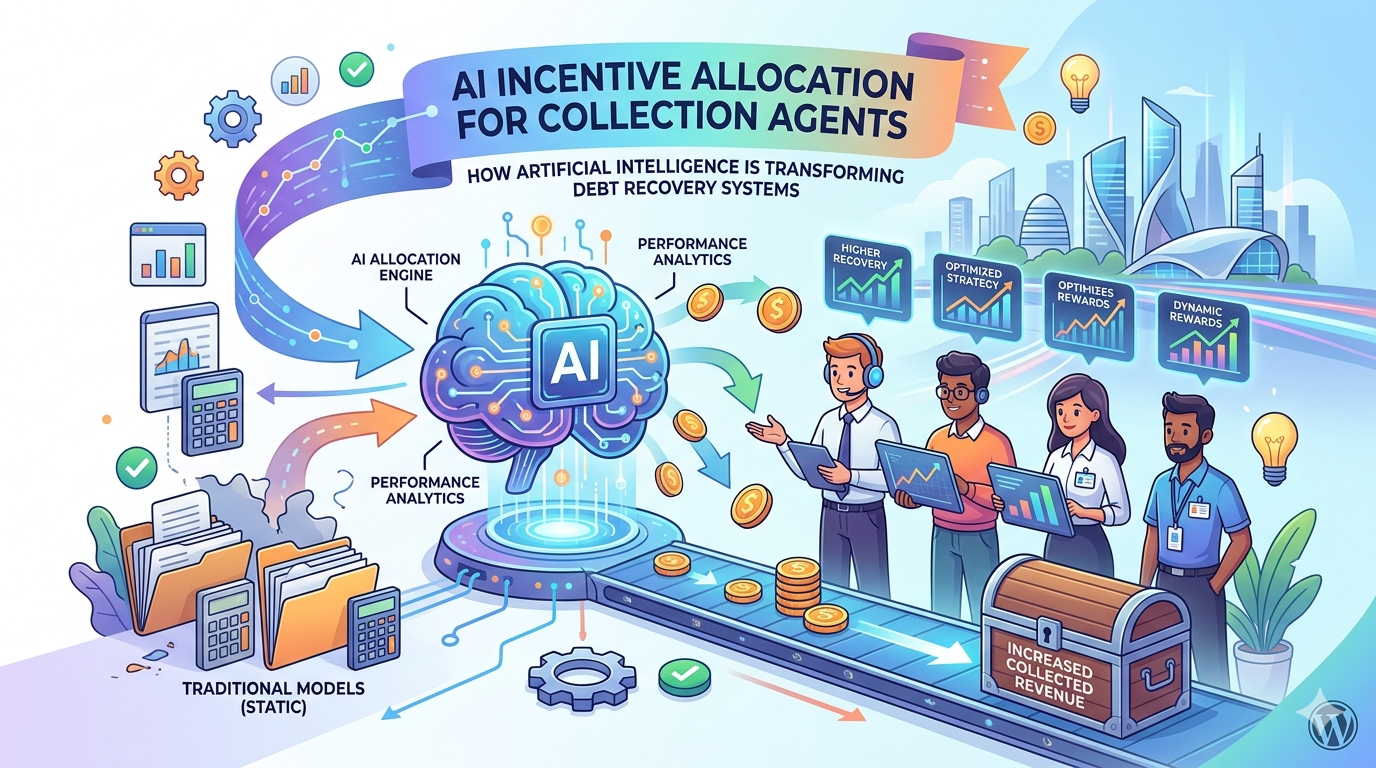
Artificial Intelligence (AI) offers a powerful solution to this challenge. By leveraging machine learning algorithms and predictive analytics, financial institutions can create intelligent incentive allocation systems that reward agents based on both performance and effort.
This article explores how AI-based incentive allocation works, its benefits, implementation strategies, and its potential to reshape the future of debt recovery.
Evolution of Debt Collection Incentive Systems
The structure of incentive systems has evolved significantly over time.
Traditional Incentive Models
Most banks historically used simple incentive frameworks such as:
- Percentage-based commission on recovered amount
- Fixed incentives per account recovered
- Monthly recovery targets
These models are easy to implement but lack sophistication.
They do not consider factors such as:
- borrower financial condition
- repayment willingness
- negotiation complexity
- number of recovery attempts
As a result, these systems may produce inefficient outcomes.
Limitations of Traditional Incentive Structures
Lack of Fairness
Agents handling easier accounts often earn more incentives compared to those managing difficult borrowers.
Reduced Motivation
When agents perceive the system as unfair, motivation declines.
Avoidance of Difficult Cases
Agents may focus on easy recoveries rather than challenging cases.
Limited Data Utilization
Traditional models rarely use historical data for decision-making.
Role of Artificial Intelligence in Debt Collection
Artificial Intelligence allows organizations to analyze large datasets and identify patterns that humans may overlook.
In debt collection, AI can:
- predict repayment probability
- classify borrower risk levels
- analyze agent performance
- optimize communication strategies
These capabilities enable the development of dynamic incentive allocation models.
AI-Based Incentive Allocation Framework
An AI-driven incentive system typically consists of several components.
1 Borrower Risk Analysis
Machine learning models analyze borrower characteristics such as:
- income patterns
- credit history
- payment delays
- employment stability
Based on this analysis, borrowers are assigned risk categories.
2 Account Difficulty Score
The system assigns a difficulty score based on:
- days past due
- borrower engagement levels
- historical repayment behavior
- number of previous recovery attempts
This score determines how challenging a particular account is likely to be.
3 Agent Effort Tracking
AI systems monitor agent activities including:
- number of calls made
- follow-up frequency
- communication attempts
- field visits
These metrics allow organizations to measure actual effort.
4 Recovery Efficiency Analysis
The system also evaluates outcomes.
Key metrics include:
- recovery percentage
- time required for recovery
- sustainability of repayment
AI Incentive Calculation Model
Using these inputs, AI calculates incentives using weighted formulas.
Example formula:
Incentive = Recovery Amount × Difficulty Score × Performance Multiplier
This approach ensures that incentives reflect both effort and outcome.
Example Scenario
Consider two agents working on similar accounts.
Agent A recovers ₹50,000 from an easy borrower.
Agent B recovers ₹40,000 from a borrower with multiple missed payments.
Traditional incentives would reward Agent A more.
AI-based systems would recognize the higher difficulty handled by Agent B and allocate higher incentives accordingly.
Benefits of AI Incentive Allocation
Improved Fairness
Agents are rewarded based on effort and complexity.
Higher Recovery Rates
Motivated agents are more likely to pursue difficult accounts.
Better Performance Management
Managers gain detailed insights into agent productivity.
Data Driven Decision Making
Organizations can optimize recovery strategies using analytics.
AI Technologies Used
Several technologies support AI-based collection systems.
Machine Learning
Predicts repayment behavior.
Natural Language Processing
Analyzes communication tone between agents and borrowers.
Predictive Analytics
Forecasts likelihood of repayment.
Implementation Challenges
Despite its advantages, AI implementation requires careful planning.
Challenges include:
- data quality issues
- system integration complexity
- regulatory compliance requirements
Organizations must invest in proper data infrastructure.
Implementation Strategy
A structured approach ensures successful deployment.
Step 1 Data Collection
Gather historical recovery data.
Step 2 Model Development
Train machine learning algorithms.
Step 3 System Integration
Integrate AI with CRM and collection platforms.
Step 4 Continuous Monitoring
Update models regularly using new data.
Future of AI in Debt Recovery
The next generation of AI systems may include:
- AI negotiation assistants
- automated borrower engagement tools
- real-time performance dashboards
These innovations will further enhance recovery efficiency.
Conclusion
AI-based incentive allocation represents a major advancement in the management of debt collection teams. By combining predictive analytics, machine learning, and performance tracking, organizations can design incentive systems that are both fair and effective.
Financial institutions that adopt intelligent incentive models will not only improve recovery rates but also create more motivated and productive collection teams.
As AI technology continues to evolve, its role in debt recovery will expand, making data-driven incentive allocation a standard practice in modern financial operations.
What is AI-based incentive allocation in debt collection?
AI-based incentive allocation is a data-driven system that uses machine learning and predictive analytics to determine fair incentives for collection agents based on account difficulty, agent effort, and recovery performance. It ensures that agents handling complex cases are rewarded appropriately.
How does AI improve collection agent performance?
AI improves collection agent performance by:
Assigning fair incentives based on effort and complexity
Identifying high-priority accounts
Providing data-driven insights for better decision-making
Encouraging agents to handle difficult cases
This leads to higher motivation and improved recovery rates.
