


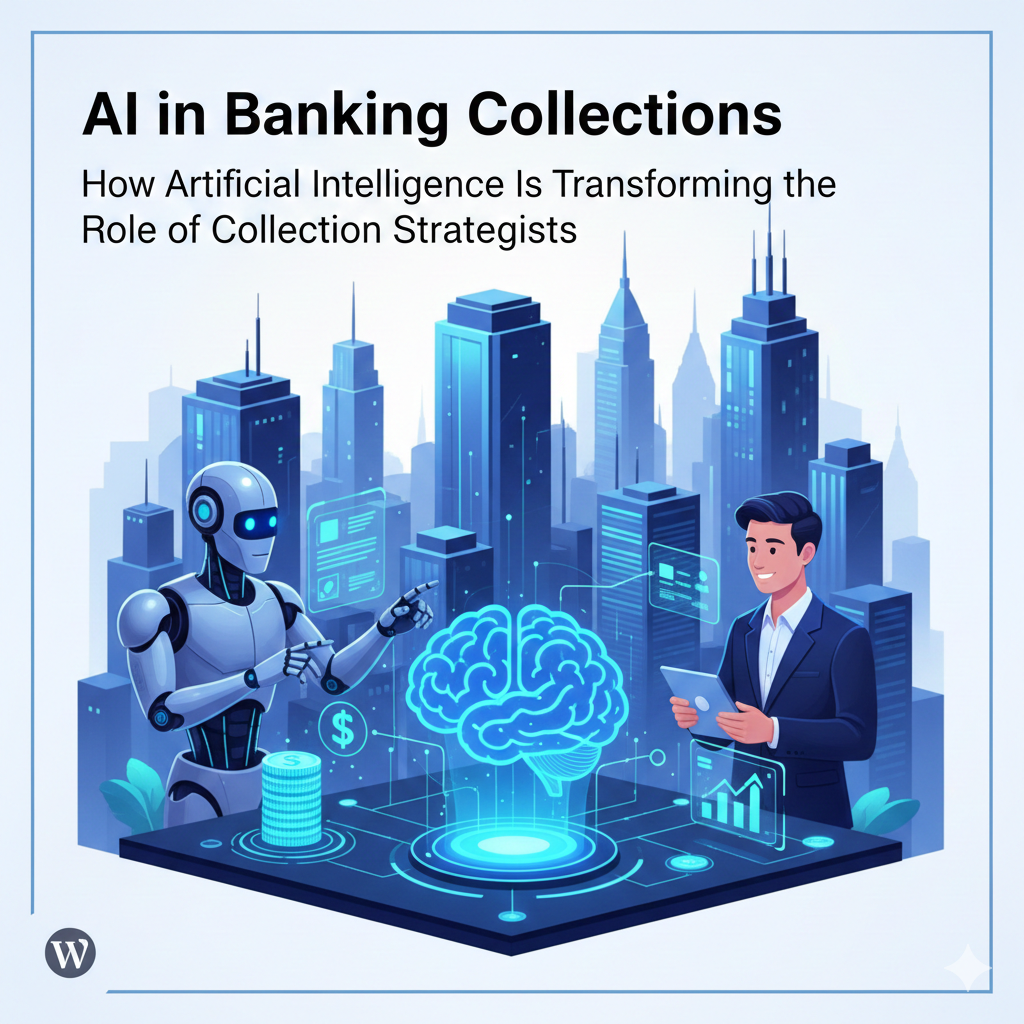
Banks today are facing rising delinquencies, tighter regulatory scrutiny, and increasing customer expectations. Traditional rule-based collection models are no longer sufficient to manage complex borrower behavior. This is where Artificial Intelligence (AI) in banking collections is becoming a game changer.
For a collection strategist, AI is not about replacing human judgment — it’s about enhancing decision-making, improving recovery rates, and reducing operational costs. Banks that adopt AI-driven collection strategies are already seeing measurable improvements in portfolio performance and customer engagement.
What Is AI in Banking Collections?
AI in collections refers to the use of machine learning, predictive analytics, and automation to optimize debt recovery processes. Unlike static rule engines, AI systems learn continuously from historical and real-time data.
Core AI Technologies Used in Collections
- Machine Learning (ML) for delinquency prediction
- Predictive Analytics for customer behavior modeling
- Natural Language Processing (NLP) for call analysis and chatbots
- Robotic Process Automation (RPA) for operational efficiency
Role of a Collection Strategist in the AI Era
The role of a collection strategist in banks has evolved from rule configuration to portfolio intelligence management.
Traditional vs AI-Driven Collection Strategy
| Traditional Collections | AI-Driven Collections |
|---|---|
| Static DPD rules | Dynamic risk scoring |
| Manual segmentation | Automated micro-segmentation |
| Uniform treatment | Personalized treatment paths |
| Lagging indicators | Predictive early-warning signals |
With AI, strategists focus more on strategy design, validation, and optimization rather than manual interventions.
Real Case Studies: AI in Banking Collections and Risk Management
Case Study #1: AI-ML Collections Analytics at a US Regional Bank
A leading regional bank in the United States employed AI/ML-based collection analytics to overhaul its collections process. By combining customer financial behavior patterns, credit utilization, transactional data, and risk scoring models, the bank was able to:
- Improve roll rates beyond targets
- Reduce staffing costs through smarter calling strategies
- Enable richer segmentation and targeted outreach
This initiative led to robust predictive analytics and measurable improvements in collections outcomes — demonstrating that AI models can outperform traditional switch-based methods significantly in real conditions. (Infosys)
Key Learnings for Collection Strategists
- Start with a specific business challenge and measurable goals.
- Validate model predictions and explainability before full deployment.
Case Study #2: AI-Powered Digital Collections in Indian Banks
A major private bank in India implemented AI-powered voicebots and omnichannel digital collections platforms. Results from this deployment included:
- 40% higher customer engagement through voicebots
- 35% reduction in human calling costs
- 25% faster collections time
- Up to 92% improvement in resolution rates
- 80% drop in outbound calling costs due to smarter channel choices
These outcomes highlight how combining AI analytics with digital first outreach boosts both efficiency and customer experience in debt recovery workflows. (credgenics.com)
Case Study #3: Mid-Sized Bank Using AI for Loan Portfolio Health
In Southeast Asia, a mid-sized bank partnered with an AI provider to modernize its entire loan value chain — including collections. Over 12 months, the bank achieved:
- 28% reduction in NPAs
- 35% increase in on-time repayments
- 40% faster credit decisioning
- Substantial decline in recovery costs
The bank’s shift to AI allowed it to detect stress signatures early, prioritize high-risk accounts, and streamline recovery actions — resulting in healthier loan portfolios. (alphaware.io)
How AI Helps Collection Strategists Improve Recovery Rates
1. Predictive Delinquency Modeling
AI models analyze repayment history, transaction behavior, bureau data, and demographic signals to predict probability of default (PD) and roll-forward risk.
Impact:
- Early identification of high-risk accounts
- Better prioritization of collection efforts
2. Intelligent Customer Segmentation
AI creates behavior-based segments rather than relying only on DPD buckets.
Examples:
- Willing but temporarily stressed borrowers
- Strategic defaulters
- Chronic late payers
This enables customized collection strategies per segment.
3. Personalized Treatment Strategy Optimization
AI recommends the right action, at the right time, via the right channel.
Treatment variables include:
- Call vs digital reminder
- Time of contact
- Message tone
- Frequency of follow-ups
Collection strategists can simulate outcomes before deploying strategies.
4. Channel Optimization Using AI
AI analyzes historical success rates to decide the best channel:
- IVR
- WhatsApp / SMS
- Field collection
- Call center
This reduces customer fatigue and improves engagement rates.
5. Early Warning Systems for Pre-Delinquency
AI models detect pre-DPD stress signals such as:
- Balance dips
- Missed utility payments
- Salary delays
Proactive nudges help prevent accounts from slipping into delinquency.
AI in Collections and Regulatory Compliance
One major concern for banks is explainability and compliance.
How AI Supports Compliance
- Transparent scorecards with reason codes
- Bias detection and monitoring
- Audit-ready decision logs
- Policy-driven AI governance
For collection strategists, this ensures alignment with guidelines, fair practice codes, and internal risk policies.
Key KPIs Improved by AI-Driven Collection Strategy
AI directly impacts measurable outcomes:
- Roll rate reduction
- Higher resolution rate
- Lower cost per collection
- Improved customer satisfaction (CSAT)
- Reduced field visit dependency
Challenges Collection Strategists Must Address While Implementing AI
AI adoption is not plug-and-play.
Common Challenges
- Poor data quality
- Integration with LMS / CBS systems
- Model explainability concerns
- Change management for ops teams
Successful strategists focus on phased implementation, continuous monitoring, and stakeholder alignment.
Future of AI in Banking Collections
The future of AI in collections is moving toward:
- Self-learning strategies
- Real-time decision engines
- Voice analytics for call effectiveness
- GenAI-powered negotiation bots
- Hyper-personalized customer journeys
Collection strategists who understand AI will become portfolio performance leaders, not just operational managers.
Conclusion: Why Collection Strategists Must Embrace AI
AI is redefining how banks manage delinquencies. For a collection strategist, AI provides deeper insights, faster decision-making, and scalable strategy execution. Banks that combine human expertise with AI-driven intelligence will lead the next phase of collection transformation.
FAQ
1: What is AI in banking collections?
AI in banking collections refers to the use of machine learning, predictive analytics, and automation to improve debt recovery, customer segmentation, and delinquency management.
2: How does AI help collection strategists in banks?
AI helps collection strategists by predicting delinquency risk, optimizing treatment strategies, personalizing customer outreach, and improving recovery rates while reducing operational costs.
3: Can AI reduce NPAs in banks?
Yes, AI helps reduce NPAs by identifying early warning signals, enabling proactive engagement, and preventing accounts from slipping into higher delinquency buckets.

1 Comment
Pingback: AI Incentive Allocation for Collection Agents: How Artificial Intelligence Improves Debt Recovery Performance